publications
publications by categories in reversed chronological order. generated by jekyll-scholar.
2026
-
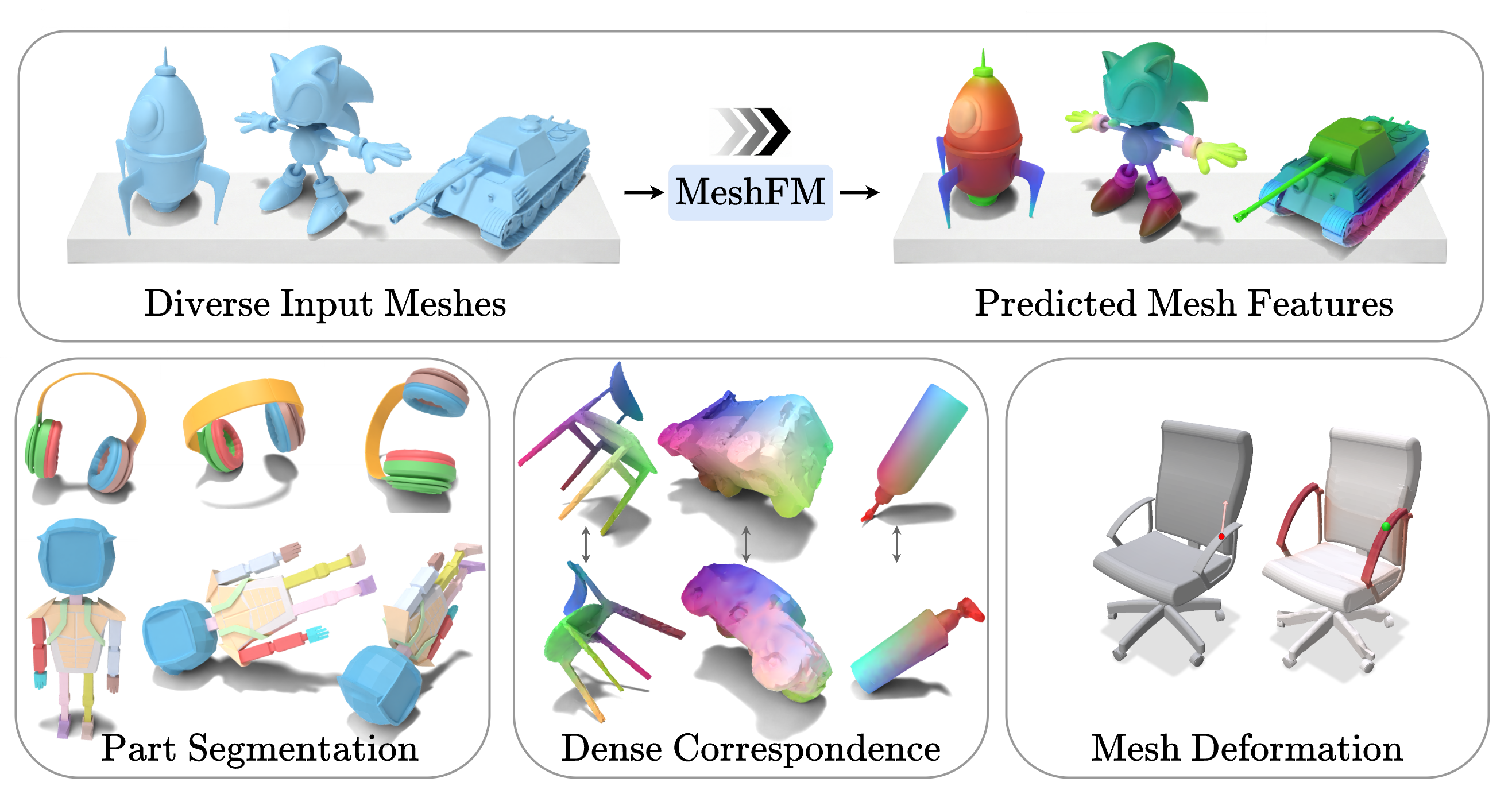 MeshFM: 2D Features Are All You Need for 3D Shape UnderstandingJinfan Zhou*, Richard Liu*, Itai Lang, and 1 more authorECCV 2026
MeshFM is a feedforward model that computes general-purpose features for 3D shapes. The learned features are discriminative and capture meaningful properties across diverse shapes and complex geometries. Importantly, the features are multi-purpose, and can be applied in a zero-shot manner for a variety of downstream tasks, such as segmentation, correspondence, and deformation.
-
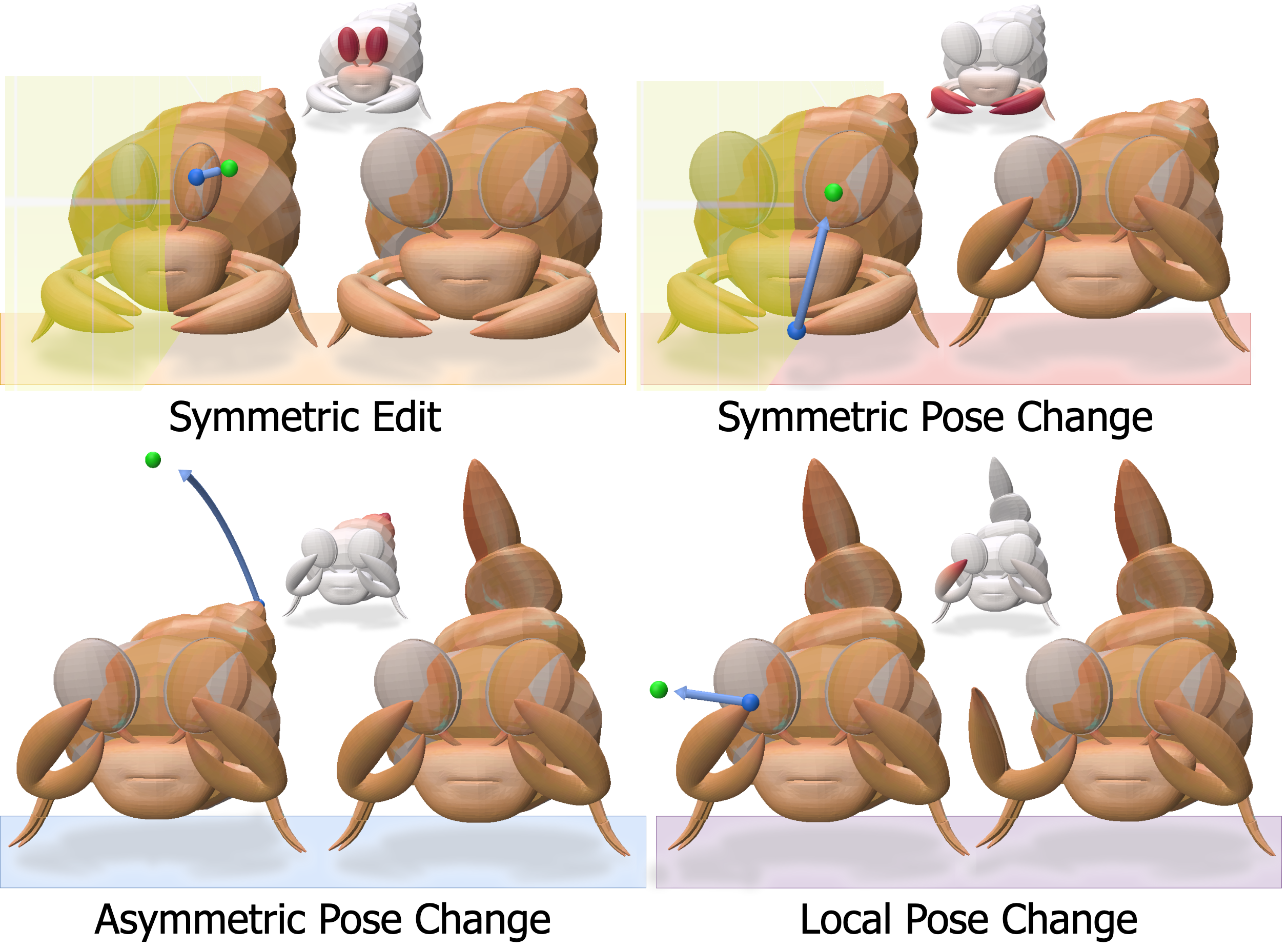 Deep Feature Deformation WeightsRichard Liu, Itai Lang, and Rana HanockaCVPR 2026
Handle-based mesh deformation has been a long-standing paradigm in computer graphics, enabling intuitive shape edits from sparse controls. Classic techniques offer precise and rapid deformation control. However, they solve an optimization problem with constraints defined by control handle placement, requiring a user to know apriori the ideal distribution of handles on the shape to accomplish the desired edit. The mapping from handle set to deformation behavior is often unintuitive and, importantly, non-semantic. Modern data-driven methods, on the other hand, leverage a data prior to obtain semantic edits, but are slow and imprecise. We propose a technique that fuses the semantic prior of data with the precise control and speed of traditional frameworks. Our approach is surprisingly simple yet effective: deep feature proximity makes for smooth and semantic deformation weights, with no need for additional regularization. The weights can be computed in real-time for any surface point, whereas prior methods require optimization for new handles. Moreover, the semantic prior from deep features enables co-deformation of semantic parts. We introduce an improved feature distillation pipeline, barycentric feature distillation, which efficiently uses the visual signal from shape renders to minimize distillation cost. This allows our weights to be computed for high resolution meshes in under a minute, in contrast to potentially hours for both classical and neural methods. We preserve and extend properties of classical methods through feature space constraints and locality weighting. Our field representation allows for automatic detection of semantic symmetries, which we use to produce symmetry-preserving deformations. We show a proof-of-concept application which can produce deformations for meshes up to 1 million faces in real-time on a consumer-grade machine.
2025
-
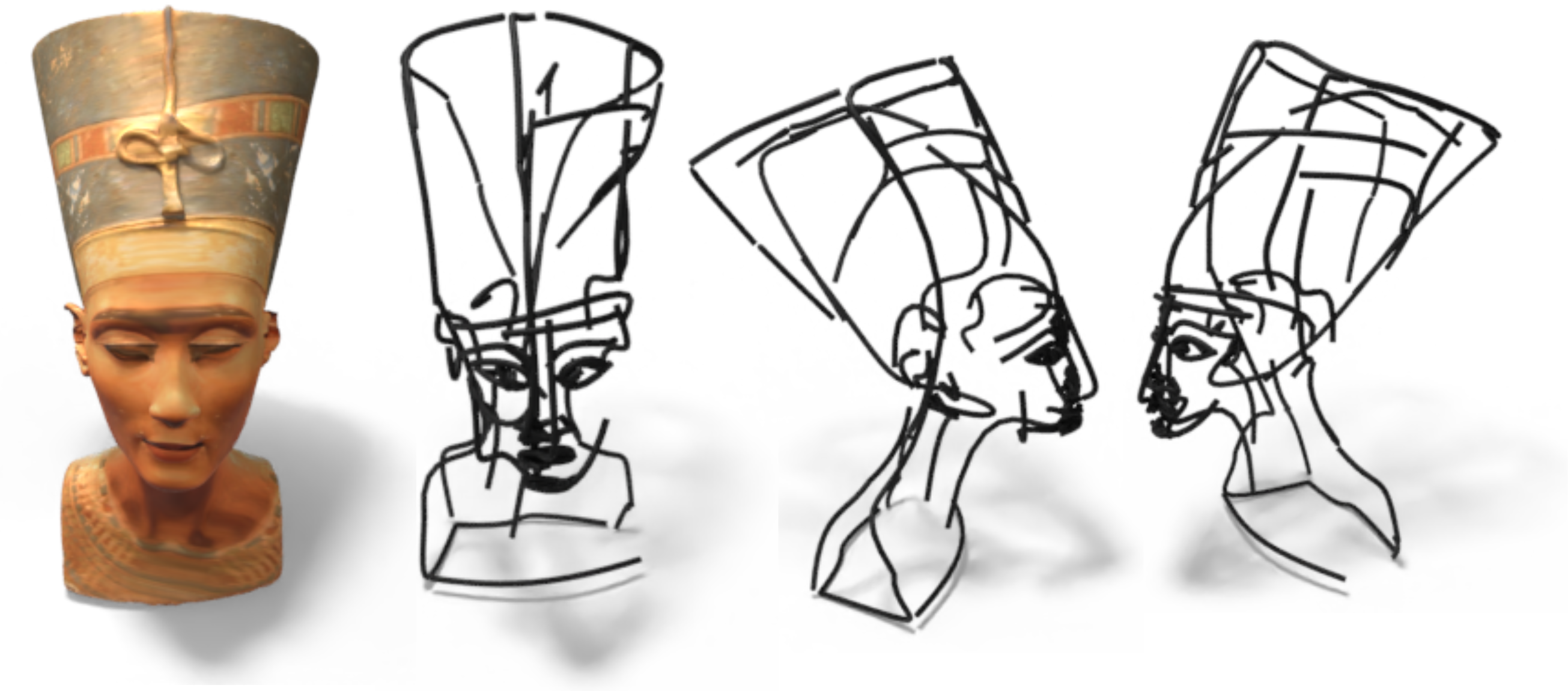 WIR3D: Visually-Informed and Geometry-Aware 3D Shape AbstractionRichard Liu, Daniel Fu, Noah Tan, and 2 more authorsICCV 2025
Top 4% of accepted papers.
We present WIR3D, a technique for abstracting 3D shapes through a sparse set of visually meaningful curves in 3D. We optimize the parameters of Bezier curves such that they faithfully represent both the geometry and salient visual features (e.g. texture) of the shape from arbitrary viewpoints. We leverage the intermediate activations of a pre-trained foundation model (CLIP) to guide our optimization process. We divide our optimization into two phases: one for capturing the coarse geometry of the shape, and the other for representing fine-grained features. Our second phase supervision is spatially guided by a novel localized keypoint loss. This spatial guidance enables user control over abstracted features. We ensure fidelity to the original surface through a neural SDF loss, which allows the curves to be used as intuitive deformation handles. We successfully apply our method for shape abstraction over a broad dataset of shapes with varying complexity, geometric structure, and texture, and demonstrate downstream applications for feature control and shape deformation.
2024
-
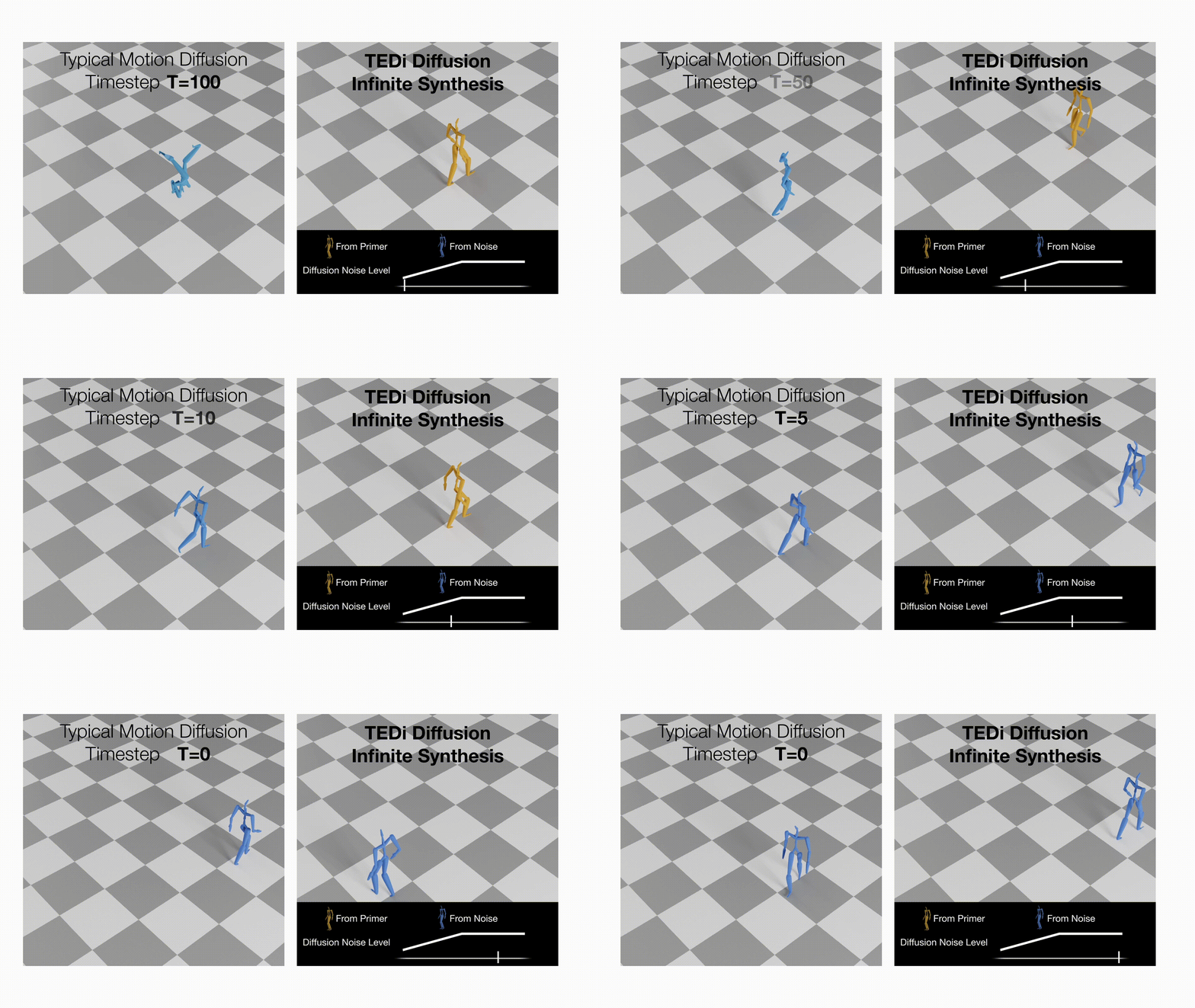 TEDi: Temporally-Entangled Diffusion for Long-Term Motion SynthesisZihan Zhang, Richard Liu, Kfir Aberman, and 1 more authorSIGGRAPH North America 2024
The gradual nature of a diffusion process that synthesizes samples in small increments constitutes a key ingredient of Denoising Diffusion Probabilistic Models (DDPM), which have presented unprecedented quality in image synthesis and has been recently explored in the motion domain. In this work, we propose to adapt the gradual diffusion concept (operating along a diffusion time-axis) into the temporal-axis of the motion sequence. Our key idea is to extend the DDPM framework to support temporally varying denoising, thereby entangling the two axes. Using our special formulation, we itera- tively denoise a motion buffer that contains a set of increasingly-noised poses, which auto-regressively produces an arbitrarily long stream of frames. With a stationary diffusion time-axis, in each diffusion step we increment only the temporal-axis of the motion such that the framework produces a new, clean frame which is removed from the beginning of the buffer, followed by a newly drawn noise vector that is appended to it. This new mechanism paves the way toward a new framework for long-term motion synthesis with applications to character animation and other domains.
-
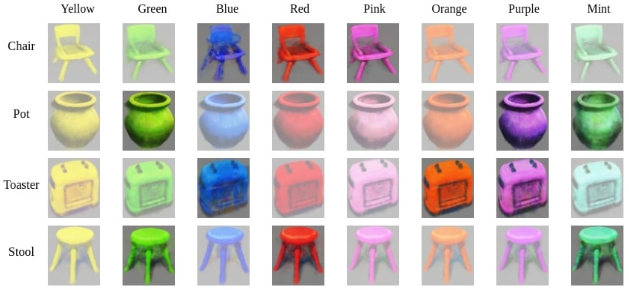 HyperFields: Towards Zero-Shot Generation of NeRFs from TextSudarshan Babu*, Richard Liu*, Avery Zhou*, and 3 more authorsICML 2024
We introduce HyperFields, a method for generating text-conditioned NeRFs with a single forward pass or with some finetuning. Key to our approach is (i) a dynamic hypernetwork, which learns a smooth mapping from text token embeddings to the space of neural radiance fields; (ii) NeRF distillation training in which we distill scenes encoded in individual NeRFs into one dynamic hypernetwork. We demonstrate that through the above techniques, the network is able to fit over a hundred unique scenes. We further demonstrate that HyperFields learns a more general map between text and NeRFs, and consquently is capable of predicting novel in-distribution and out-of-distribution scenes either zero-shot or with a few finetuning steps. HyperFields finetuning benefits from accelerated convergence thanks to the learned general map, and is capable of synthesizing novel scenes 5 to 10 times faster than existing neural-optimization based methods. We finally demonstrate that the learned representation is smooth, through smooth interpolation of text latents across different NeRF scenes.
-
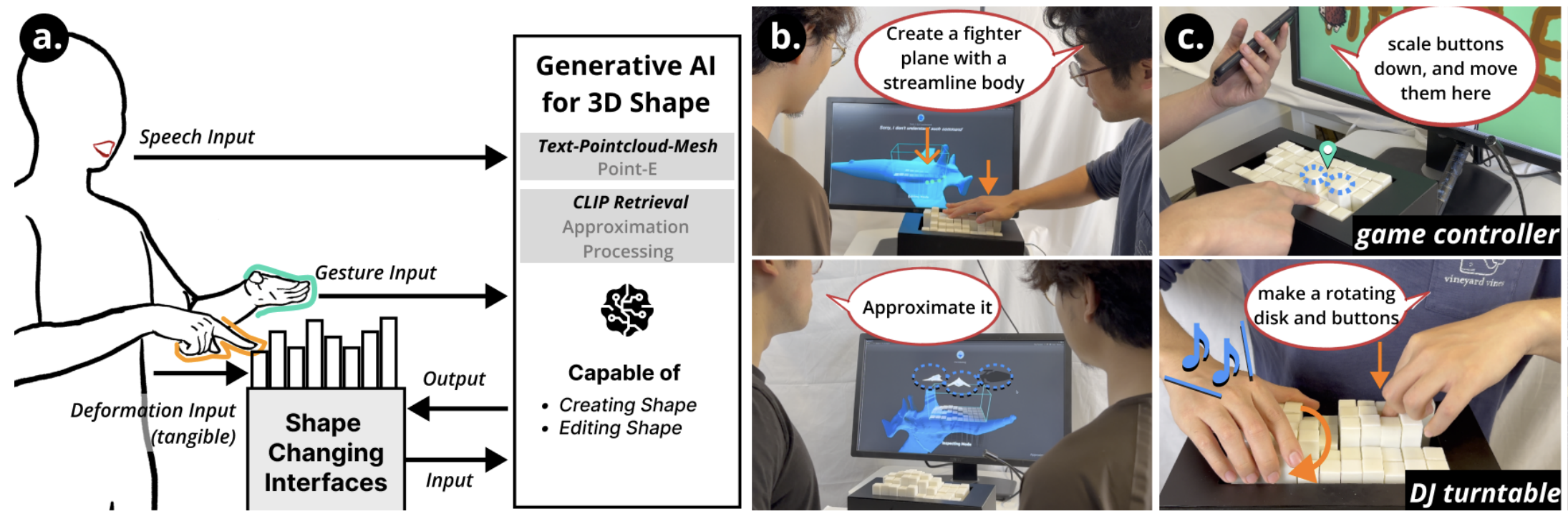 Towards Multimodal Interaction with AI-Infused Shape-Changing InterfacesChenfeng Gao, Wanli Qian, Richard Liu, and 2 more authorsUIST 2024
We present a proof-of-concept system exploring multimodal interaction with AI-infused Shape-Changing Interfaces. Our prototype integrates inFORCE, a 10x5 pin-based shape display, with AI tools for 3D mesh generation and editing. Users can create and modify 3D shapes through speech, gesture, and tangible inputs. We demonstrate potential applications including AI-assisted 3D modeling, adaptive physical controllers, and dynamic furniture. Our implementation, which translates text to point clouds for physical rendering, reveals both the potential and challenges of combining AI with shape-changing interfaces. This work explores how AI can enhance tangible interaction with 3D information and opens up new possibilities for multimodal shape-changing UIs.
2023
-
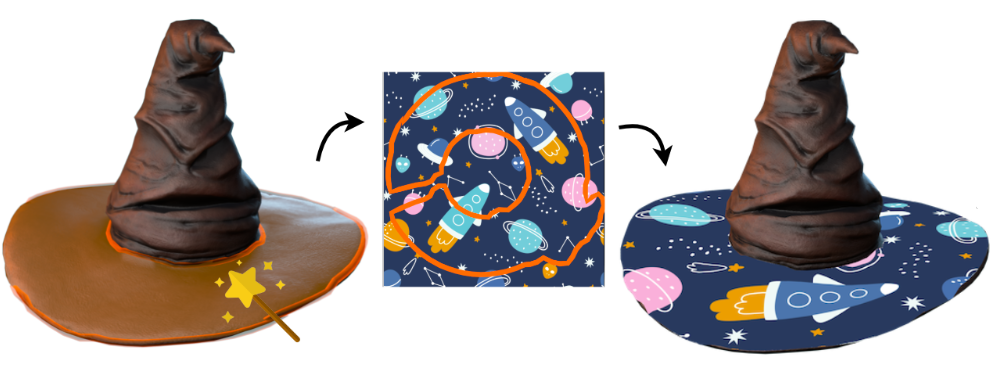 DA Wand: Distortion-Aware Selection Using Neural Mesh ParameterizationRichard Liu, Noam Aigerman, Vladimir G. Kim, and 1 more authorCVPR 2023Blender extension available here
We present a neural technique for learning to select a local sub-region around a point which can be used for mesh parameterization. The motivation for our framework is driven by interactive workflows used for decaling, texturing, or painting on surfaces. Our key idea is to incorporate segmentation probabilities as weights of a classical parameterization method, implemented as a novel differentiable parameterization layer within a neural network framework. We train a segmentation network to select 3D regions that are parameterized into 2D and penalized by the resulting distortion, giving rise to segmentations which are distortion-aware. Following training, a user can use our system to interactively select a point on the mesh and obtain a large, meaningful region around the selection which induces a low-distortion parameterization.
2022
-
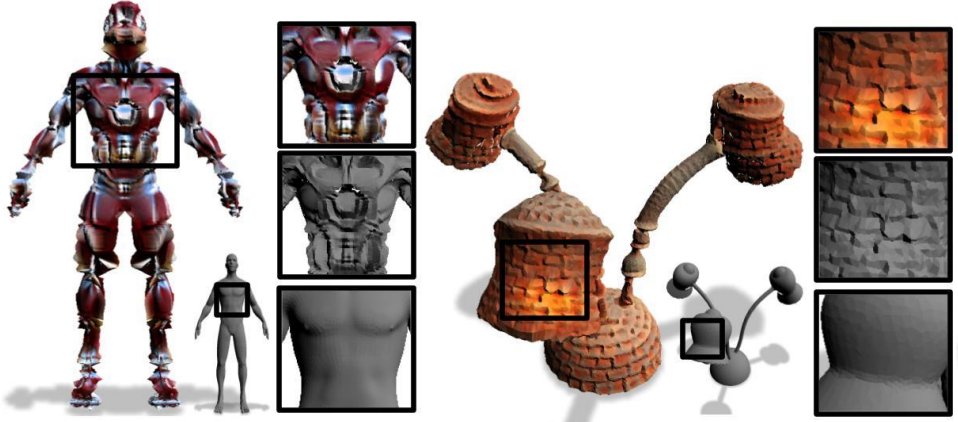 Text2Mesh: Text-Driven Neural Stylization for MeshesOscar Michel*, Roi Bar-On*, Richard Liu*, and 2 more authorsCVPR 2022
Top 16% of accepted papers.
In this work, we develop intuitive controls for editing the style of 3D objects. Our framework, Text2Mesh, stylizes a 3D mesh by predicting color and local geometric details which conform to a target text prompt. We consider a disentangled representation of a 3D object using a fixed mesh input (content) coupled with a learned neural network, which we term neural style field network. In order to modify style, we obtain a similarity score between a text prompt (describing style) and a stylized mesh by harnessing the representational power of CLIP. Text2Mesh requires neither a pre-trained generative model nor a specialized 3D mesh dataset. It can handle low-quality meshes (non-manifold, boundaries, etc.) with arbitrary genus, and does not require UV parameterization. We demonstrate the ability of our technique to synthesize a myriad of styles over a wide variety of 3D meshes.